Wednesday, 4 November 2020

PHYSICALLY HANDICAPPED

Physical handicaps and those individuals who have orthopedic defects which limit their physical activity and capacity

Cerebral palsy – refers to disorders resulting in muscular incoordination and loss of muscle control. Victims appear to be mentally retarded.

Polio – is common during childhood and is caused by a virus called poliovirus. The virous produces paralysis by destroying neuron cells in the spinal cord.

Spina bifida – is a defect of the vertebral column (laminae fail to unite at the midline). In serious cases there is partial or complete paralysis

Epilepsy – is a common neurological disorder. It is caused because of brain damage at birth, infections, head injuries, tumors, etc.

Muscular Dystrophy – is an inherited muscle destroying disease which degenerates muscle fibers and leads to non-development of skeletal muscles.  

There are various causes

-       Accidents

-       Malnutrition during pregnancy

-       Birth injuries, brain damage / serious illness during childhood

-       Hereditary factors

-       Medicines used for relief from morning sickness during pregnancy (e.g. Thalidomide Baby Episode – Thalidomide tablets were used to relieve morning sickness… however women who consumed the tablets gave birth to physically handicapped children… no limbs, no arms)

Physically handicapped should be rehabilitated and should have occupational and physiotherapy. They can be helped with surgeries, artificial limbs, prosthetics or other support devices. Polio can be prevented by vaccination during childhood.

We must be aware of the difficulties faced by those with physical handicaps and sensitive to their needs. Offer assistance if required, however, being sensitive is of utmost importance. Understanding and patience are also important factors.  

Monday, 2 November 2020

HISTORY OF HINDI JOURNALISM

The first Hindi newspaper Oodhund Martand, a weekly was published in Kolkata on May 30, 1826. However, its editor Yugal Kishore Shukla faced many difficulties in running it. He was not allowed postal concession and had to close down the paper within a year. He made an attempt to start another paper in 1850 called Samyadani Martand but this also failed. 

The second Hindi newspaper Bangadoot was published in 1829 by Raja Ram Mohan Roy and Dwarika Prasad Thakore with Nilratan Haldar as its editor. Besides Hindi, it was also published in English, Bengali and Persian.

The first Hindi daily Samachar Sudha Varshan came out in June 1854 from Kolkata with Shyam Sundar Sen as its editor and publisher. It was a bilingual paper in which market and shipping reports were published in Hindi, the rest in Bengali.

Between 1850 and 1857 a number of Hindi Newspapers were published. Among them were Benaras AkbarSudhakar Tatwa BodhiniPatrika and SathyaBenaras Akhbar (1849) was the first paper to introduce Devnagari script in the North-West provinces. Some papers of this time used to carry both a Hindi and Urdu name and used to publish news in both languages in parallel columns, for example Sarvopkarak (Mufid-ul-Khaliaq), published from Agra in 1861 and the Bharat Khandamitra (Ab-i-hayat-i-Hind), published in 1864. But this trend did not last long. 

A literary magazine which set the standard for Hindi Journals in the early years was  Saraswathi, a monthly edited by Mahavir Prasad Dwibedy. It standardised the style and pattern of Hindi journalism and developed literary criticism and book reviews. It became the torchbearer for later day Hindi journalists who cultivated its prose style.

Newspapers like Bharat Mitra (1878), Sarsudhanidhi (1879), Uchit Wakta (1880) and Hindi Bangavasi (1890) were published from Calcutta during the last three decades of 19th  century. Bharat Mitra, published from Calcutta became the leading Hindi newspaper of the time under the dynamic stewardship of its early editors, Balmukund Gupta and Ambika Prasad Bajpai.

Approximately 150 papers and journals were either started or restarted between 1884 and 1894. The contents of most of these papers were concerned with social or religious subjects, many of them were sectional, some were political and a few set a high literary standard.

The beginning of the new century saw the birth of many Hindi dailies in Bombay, Calcutta and Patna. The more prominent among them were Sri Venkateswar Samachar  and  Calcutta  SamacharViswamitra, which was started after the Calcutta Samachar became defunct, offered serious competition to Bharat Mitra from 1918.

Hindi journalism made rapid progress during the First World War period and many outstanding journalists came to the fore including Ganga Prasad Gupta, Nanda Kumar Deo Dharma, M. P.  Dwivedi, Hari Krishna Jouhar, Chhote Ram Shukla, Indra Vidyavachaspati, Shri Ram Pandey, Lakshminarayan Garde and Narmada Prasad Misra. One of the foremost Hindi journalists who earned a name for his patriotism was Ganesh Shanker Vidyarthi. In 1913, he brought out weekly Pratap from Kanpur. He made the supreme sacrifice in 1931 in the cause of Hindu-Muslim unity. Krishna Dutt Paliwal brought out Sainik from Agra which became a staunch propagator of nationalism in Western U. P. The noted Congress leader, Swami Shradhanand, started the publication of Hindi journal Vir Arjun and Urdu journal Tej. After the assassination of Swami Shradhanand, Vidyavachaspathi and Lala Deshbandhu Gupta, both prominent Congress leaders continued the publication of these journals.

At the turn of the century almost all Calcutta based Hindi newspapers went vocal against the suppressive and divisive policies of the Raj. This marked the beginning – in 1907- of two outstanding magazines: Nrisinha and Devnagar. Nrisinha edited by Ambika Prasad Vajpayee, a stauch supporter of Lokmanya Tilak was a political magazine and it joined the protest against British rule. Devnagar on the other hand tried to work on a uniform script.

In 1920, the Aj was started in Banaras. It played a notable part in the freedom struggle. Its first editor was Sri Prakasa, a great freedom fighter who occupied positions of power and prestige in free India. He was assisted by Babu Rao Vishnu Parakar whose contribution to the development of Hindi Journalism was considerable. Espousing the national cause and waging a never-ending battle with the alien rulers, the Aj was a bulwark of the Indian National Congress and its main forum to spread the message of freedom to the Hindi-speaking masses of Uttar Pradesh, Bihar, Madhya Pradesh and Nepal. It set the tone and style for Hindi Journalism and was acclaimed for its impartial objective reporting and illuminating and fearless editorials. A balanced blending of national and international news was one of its strong features.

In Patna the Desh, a weekly, was an influential journal and the mouthpiece of the Congress. It was founded by Babu Rajendra Prasad and his friends in 1920. But it was not a profitable venture and had to close down.

In 1924 there were 102 Hindi newspapers; four of them were dailies (AJ, Banaras,  Swatantra, Calcutta, Arjun, Delhi and Calcutta Samachar, Calcutta) According to a historian, until 1926, Hindi dailies were not financially successful.  “Their get up and printing was poor, the reading material not quite up to the mark and the editorials unwieldy and lengthy. The weeklies were better edited and got up.” Among the well-known better produced weeklies were Bhavishya (Kanpur), Karmaveer (Khandwa) and Sainik (Agra).

Among the important Hindi dailies which flourished in 1930 were:   Viswamitra and Bharat Mitra (Calcutta), Savadho  Bharat  (Bombay), Lokkat (Jabalpur), Variman (Kanpur),   Milap (Lahore)  besides AJ (Banaras), Arjun (Delhi) and Lokmanya (Calcutta).

As the freedom struggle gained momentum, there was a steady rise of Hindi journalism both in terms of quality and quantity. More Hindi publications started in almost all North Indian states and also in Maharashtra, Bengal, and Andhra Pradesh, especially Hyderabad. Hindi publications like other language publications by and large supported the Nationalist movement and faced the suppression of the British rulers. One of the important Hindi dailies to be published from the capital was Hindustan, sister newspaper of the Hindustan Times, started in 1936.  Wide news coverage and a variety of special features marked the  Hindustan. Started in 1940, Aryavari of Patna was a sister publication of the Indian Nation and enjoyed considerable influence.

Hindi journalism grew more rapidly after independence. After independence Hindi was adopted as the official language of India. This also helped to spread Hindi language nationwide. The NavBharat Times of the Times of India group started in Delhi in 1950. The Amrita Patrika of Allahabad was another notable Hindi daily which was well-known for its editorials. By 1964 Hindi had the largest number of newspapers among language papers. The trend of publishing multiple editions from different states helped Hindi newspapers to increase their reach and circulation.

According to RNI (Registrar of Newspapers in India) the total number of publications in Hindi was 27,527 in 2007-8 including 3418 daily newspapers and 12793 weeklies.

By mid 2011 Hindi daily Dainik Jagran claimed to be the largest read newspaper of the world. Six out of the top ten newspapers with highest number of readership in India were Hindi. According to IRS (Indian Readership Survey the top ten largest read Hindi newspapers are: Dainik Jagran (readership: 164.1 lakh), Dainik Bhaskar (146 lakh), Hindustan (120.4 lakh), Amar Ujala  (88.4 lakh), Rajasthan Patrika (68.47 lakh), Punjab Kesari (33.30 lakh),  Navbharat Times (25.73 lakh) Prabhat Khabar (21.87 lakh), Patrika (17.87 lakh) and Nai Dunia (16.49  lakh). All of the newspapers have multiple editions from different cities and states.

Hindi newspapers are published from several states. Besides the North Indian Hindi belt, sizable numbers of Hindi publications are there in West Bengal, Maharashtra, Gujarat and other states. There are two popular Hindi dailies from Hyderabad – Swatantra Vaartha  and Milap. Kolkata based Sanmarg has an edition from Bhubaneswar, Odisha too. Assam also had Hindi newspapers. Dainik Lokamanya was the first Hindi newspaper of Assam. It was published in 1963 in Guwahati by Pandit Ramshankar Tripathi. The four page broadsheet was priced 10 paisa. It survived only for few months.

Few interesting facts:

-       The Indian language newspapers covered the mental gap between readers in rural areas and the English language press

-       Local language newspapers reflected the views of their readers more accurately and in clearer terms than English newspapers

-       Hindi newspapers played a constructive role in the promotion of government policies

-       Hindi newspapers helped the understanding of political process and as a result more and more people were attracted to active politics

-       Hindi newspapers played an important role during elections for propaganda and views on local affairs


ToTo watch the video click the link: History of Hindi Journalism

Sunday, 1 November 2020

BRIEF HISTORICAL BACKGROUND OF THE CONSTITUTION OF INDIA

 Historical Background

The Constitution of Indian Republic is the product of the research and deliberations of a body of eminent representatives of the people who sought to improve upon the existing system of administration.

Government of India Act 1858

1858 British assumed sovereignty over India from East India Company

Power was exercised by Secretary of State for India and Council of Ministers

Features:

a.    Administration was centralized. Territories were divided into provinces with a Governor. Governor reported to Governor general

b.    All authority – civil, military, executive and legislative – in the hands of Governor General who was responsible to Secretary of state

c.    Control of Secretary of State over Indian administration was absolute. He had the last work in all matters.

Indian Councils Act 1861

Governor Generals Executive Council which was composed exclusively of officials, would not have some unofficial members transacting business. But this council was neither representative nor deliberative. Prior sanction of Governor General was necessary.

Indian Councils Act 1892

Two improvements

1.    Non official members of Indian Legislative Council were not to be nominated by Bengal Chamber of Commerce and non official members of Provincial Council were to be nominated by local bodies such as universities, district boards, municipalities, etc.

2.    Councils would have the power to discuss annual statement of revenue and expenditure.

Morley Minto Reforms and India Councils Act 1909

Morley Minto Reforms first introduced a representative and popular element

Secretary of State for india (Lord Morley) and Viceroy (Lord Minto)

Features:

a.    Size of Council was enlarged

b.    Element of election introduced in legislative council

c.    Functions of legislative council increased and they were given the opportunity of influencing the policy of administration by moving resolutions on budget and on any matter of public interest except certain subjects such as armed forces, foreign affairs and Indian states

d.    It provided for the first-time separate representation of Muslim community and thus sowed the seeds of separatism that ultimately led to the partition of India (Muslim League formed as a political party after this in 1906).

Government of India Act 1915

To consolidate all earlier Government of India Acts

Montague Chelmsford Report and Government of India Act 1919

Features:

a.    Dyarchy in provinces – Introduced responsible government (dual government) Central dealing with subjects of all India importance and Provincial dealing with primary matters

b.    Relaxation of Central control over the Provinces. Budgets were separated and provincial legislature was give power to present its own budget and levy its own taxes. (The Center retained power as final sanction would be from the center).

c.    Indian legislature made more representative

Bicameral – two houses (Upper House – Council of State and Lower House – Legislative Assembly)

Simon Commission (Black Act) and Government of India Act 1935

Introduced ‘Communal Award’ – Another way of increasing the rift between Hindus and Muslims

Features:

a.    Federation ad Provincial Autonomy

b.    Optional for Indian states to join federation

c.    Provincial Autonomy – divided power between Provincial and Central Legislatures.

Indian Independence Act 1947

With effect from 15 August 1947 India ceased to be depend on the British Crown (Office of Secretary of State for India was abolished).


MAGAZINE ADVERTISING

Magazines are of three types –

General interest magazines like India Today and Outlook

Business magazines like Business India, Business World or Business Today

Special magazines for niche markets like Eastern Pharmacist for pharmacists. Professional journals are also specialized magazines like the journal for chartered accountants, company secretaries and costs and works accountants.

Advantages of Magazine Advertising

The newspapers and magazines have different advantages though both belong to the print media.

The peculiar advantages of magazines are:

1. Demographic selectivity: Every magazine has a different audience whose demographic and psychographic characteristics are different. Thus Femina is a magazine for young women, whereas Savvy is a magazines for mature women. Manohar Kahaniyan has a typical audience of north Indian middle class. Each magazine thus helps us to target at a particular age group, gender group and income group. Special interest magazines provide a specific audience.

2. Geographic Selectivity: Some magazines have all-India circulation like India Today. Some magazines are confined to a region like Malayalam Manorama. So magazines help us target a geographic market we require without considerable waste.

3. Creative Flexibility: High fidelity reproduction is a speciality of magazines on account of their superior quality of paper and printing. They also provide opportunities for innovative adds like pop-up ads, sample-bearing ads, scented ads, outside inserts as booklets.

4. Durability of Message: Magazines are kept for a longer time, and are read again and again. More time is devoted to reading a magazine. It means that the chances of the ad message being seen are more in magazines. As the magazines is preserved for a longer time, the message has a durability of longer duration.

Disadvantages of Magazines Advertising

In spite of several advantages, magazines have many drawbacks as advertising media.

1. Lead Time Longer: The ad material will have to be submitted much in advance because a magazine requires elaborate production plan. The lead time is sometimes 90 days before the release of an issue. It is difficult to change the message on account of changed circumstances and contingencies. These days magazines are trying to shorten the lead time as much as they can.

2. Limited Reach and Frequency: Magazines have limited reach as far as the total number of households are concerned. To reach a larger audience, it is necessary to buy a lot of magazine space. As their periodicity is either a month or a fortnight or a week, it is difficult to have higher frequency. To overcome this drawback, a media planner uses several magazines or adds other media to supplement magazine ads.

3. No Sound and Motion: Magazines rely upon the printed copy and visuals to convey the message, and lack the sound of radio or motion of TV which makes these audio-visual ads greatly effective.

Magazine buying:

Factors affecting the choice of Magazine are as follows

While planning magazine ads, we have to consider factors like circulation and readership, ad rates, placement of ads, special facilities given by the magazines.

 1. Circulation and Readership: Circulation figures indicate the number of people who will get to see the ad. But circulation for magazines keeps on fluctuating. The ad rates are based on guaranteed circulation. It is the figure of those least number of copies which will be delivered. Primary readership of a magazine is the readership of actual buyers or subscribers. Secondary readership get to read the magazine as it is passed on by the primary readers. Secondary readership is a matter of research. It always exceeds the circulation. (ABC) Audit Bureau of Circulation certifies a magazines circulation.

2. Magazines Ad Rates: The rate card shows the rate to be paid and production specifications. It also spells out agency’s commission policy and provides other relevant information. There are separate rates for Black and White and colour ads. The rates increase depending upon the number of colour used. Bleed ad has its background colour spread all over the page till its edges. It carries an extra charge. Magazines offer a variety of sizes – full-page, half-page, quarter-page ads. Fractions of a page in several combination can be offered. Gatefold ad opens like a safe, when its two folds are opened. It occupies an extra-wide page.

Run-of-press ads are placed anywhere. The basic rates quoted by a newspaper entitle the ad to a run-of-paper (abbreviated ROP) position anywhere in the paper that the publisher chooses to place it, although the paper will be mindful of the advertiser's request and interest in getting a good position. An advertiser may buy a choice position by paying a higher, preferred-position rate, which is similar to paying for a box seat in a stadium instead of general admission. A cigar advertiser, for example, may elect to pay a preferred-position rate to ensure getting on the sports page. A cosmetic advertiser may buy a preferred position on the women's page. There are also preferred positions on individual pages. An advertiser can pay for the top of a column or the top of a column next to news reading matter (called full position).

Each newspaper specifies its preferred-position rates; there is no consistency in this practice. Preferred-position rates are not as common as they once were. Now many papers simply attempt to accommodate advertisers that request a position, such as "above fold urgently requested."

a. Preferred-position Rates: each newspaper specifies its preferred-position rates.

b. Combination Rates: A number of combinations are available to advertisers. What they all have in common is the advantage of greatly reduced rates for purchasing several papers as a group.

c. Multiple Rate card: Many Newspapers offer a number of rate cards for different categories of advertisers. 

3. Audience Selectivity: As we noted earlier, the audience niche reached by a publication is normally the starting point for evaluating a magazine. Successful magazines tend to appeal to relatively audience segments, especially compared to the general magazines of the 1950s such as Life, Look, and The Saturday Evening Post. However, today even the largest – circulation publications have an identifiable editorial focus. Sports Illustrated, TV Guide, and Modern Maturity all reach millions of readers but concentrate on relatively few topics.

The closest publications to the general – circulation magazines of the past are Reader’s Digest and the newspaper – distributed supplements USA Weekend and Parade. However, it is apparent that the typical consumer magazine reaches a particular demographic or lifestyle category. The combination of clearly defined demographics and compatible editorial environment make magazines important to many advertisers, either as the primary building block of a media schedule or as a valuable supplement to other media.

4. Exposure to a company’s primary target audiences. Magazines can reach narrowly defined audience segments, especially among high – income households. There is no question that magazines represent the most efficient means of reaching a significant segment of affluent prospects. Furthermore, the majority of this audience are not heavy users of other media. Therefore, when the marketing objective is to reach affluent customers, magazines will almost always play a central role in the advertising plan.

For more and more national advertisers, the decision is not one of deciding between magazine and television, but rather how to use them as complementary media. A study commissioned by the MPA found the following:

The combination of print and television produces greater communication of brand attributes than print alone or television alone.

The selection of a brand versus its competitors increases more when print and television are used in conjunction with each other than when television or magazines are used separately.

It is evident that advertisers must plan their creative strategies and executions to strengthen and enhance the communication objectives for both media. The complementary advantages of combining magazines and television are greatly reinforced when creative strategies are complementary for both media.

5. Long life and creative options. A TV commercial is over in 30 seconds, we whiz by a highway billboard so quickly that only a fleeting glance is possible, and the average newspaper is in the recycling bin before we leave for work. In this disposable media world, magazines stand alone as a tangible vehicle. Magazines are often used as reference sources. Articles are clipped, back issues are filed, and readers may go back to a favourite magazine numerous times before finally discarding it. Advertisers potentially benefit from each of the exposures.

Magazines also offer advertisers a wide range of flexible formats such as double-page spreads, bright colours, even product sampling. Magazines are particularly suited to long copy. Discussions of detailed product attributes for automobiles and appliances as well as advertising for financial services all lend themselves to magazines.

6. Qualitative factors. Advertisers buy magazines based on their ability to deliver a particular audience at a reasonable cost. However, more than any other medium, magazines depend on less easily measured, qualitative criteria that advertisers traditionally look for in magazines are the following:

7. Credibility. Many consumer magazines are considered the leading authority in their field. Car owners look to Road & Track, hunters to Sports Afield, stockholders to Fortune, and gardeners to Southern Living as sources of reliable information. As we discussed earlier, it is this position of magazines as authoritative sources that led to so many cross-media spinoffs into other media. Sometimes the relationship between media credibility and advertising is direct. For example, the Good Housekeeping Seal has been used by Good Housekeeping magazine for more than 50 years as a method of endorsing products that are advertised in the publication. In other cases, the connection is less obvious but nevertheless an important part of the qualitative selling environment of magazine advertising.

8. Compatible editorial environment. When a person picks up Golf Digest, Glamour, or PC Computing, there is little doubt about their interests. These same readers also watch prime-time television, listen to the radio on the way home from work, and see numerous billboards each day. However, it is difficult o anticipate what they are thinking about on these moments. On the other hand, specialized magazines can practically guarantee a synergism between reader and editorial content.

9. Reader involvement. The average reading time for a consumer magazine is 52 minutes. More importantly, the more highly educated a reader, the more thoroughly he or she reads a magazine. Studies show that readers with a college degree are exposed to the average magazine page more frequently and also are more likely to see the advertisements. Reader involvement is related to the credibility and editorial relationship that readers develop with their favorite magazines. While not easy to quantify, these factors play a role in determining in which medium advertisers will invest their money.

10. Long closing dates. Unlike the spontaneity of radio and newspapers, magazines require a long lead time between when advertising material must be submitted and when the ad will run. For example, a magazine advertisement may run 8 to 10 weeks after an advertiser submits it. This long lead time makes it difficult for advertisers react to current marketing conditions either in scheduling space or developing competitive copy. The long closing dates are one reason why most magazine copy is very general.

11. Ad Banking. While not an inherent disadvantage of all magazines, ad banking is a practice that some advertisers do not like. Ad banking is the practice of publications such as National Geographic to cluster (or bank) all the advertisements toward the front and back of the publication. Advertisers fear that banking creates advertising clutter and makes it less likely that their advertising will gain high readership. Some advertisers exclude such publications from their media schedules.

12. Availability of partial runs editions: advertisers buying not the entire circulation but a part of the circulation. On a national scale, magazine demographic and geographic editions meet the same demands of large advertisers. It is very rare that a national magazine does not offer some type of regional or demographic breakout of its total circulation. These special editions are called partial runs and are very common and important to magazine advertising.

Demographic Editions. Major magazines routinely offer advertisers those pin codes with the specific SEC. Advertisements can limit their ads to subscribers in those areas.

Vocational Editions. A magazine may identify professionals or executives among its readers and allow advertisers to purchase a partial-run directed only at these readers.

Geographic edition: The oldest, and still most available, form of partial-run is the geographic edition. Depending on the publication, a magazine may offer a combination of city, state, or regional editions.

One advantage of geographic editions is that they can be used for both subscriptions and newsstand sales, whereas both demographic and vocational editions are confined to subscribers. It is extremely common for even relatively small circulation magazines to offer some form of partial-run advertising.

Split-Run Editions

It is a special form of the partial-run edition. Split-run editions normally are used by both advertisers and publishers for testing purposes. The simplest form of split-run test is where an advertiser buys a regional edition (a full-run is usually not bought because of the expense) and runs different advertisements in every other issue.

Each advertisement is the same size and runs in the same position in the publication. The only difference is the element being tested. It may be a different headline, illustration, product benefit or even price.

Partial-run and split run editions offer a number of benefits to advertisers.

1. Geographic editions allow advertisers to offer products only in areas where they are sold.

2. Partial-run can localize advertising and support dealers or special offers from one region to another. As advertisers, increasingly adopt local and regional strategies, the partial-run advantages will become even more apparent.

3. split-run advertisement allows advertisers to test various elements of a campaign in a realistic environment before embarking on a national rollout.

4. Regional editions allow national advertisers to develop closer ties with their retailers by listing regional outlets. This strategy also provides helpful information to consumers for products that lack widespread distribution.

Partial-run editions also have disadvantages:

1. CPM levels are usually much more expensive than full-run advertising in the same publication and close dates can be as much as a month earlier than other advertising.

2. In the case of demographic editions, the lack of newsstand distribution for these advertisements can be a major disadvantage if single-copy sales are significant for the publication.

3. Some publications bank their partial-run advertising in a special section set aside for such material.

Various Kinds of rebates, discounts and rates offered in print media buys

1. Scatter buys

2. Upfront buys

3. Make goods

4. Spot buys

5. Bulk discounts

6. Full buy or partial run

7. Reach

NEWSPAPER ADVERTISING

 Types of Newspapers Advertising

1.      Display advertising: To differentiate advertising from editorial matter, display advertising is designed comprising the copy, the layout, and the visuals. These ads come in all sizes. They are placed all over in a newspaper, depending upon the policy of that paper. Display advertising is national or local.

2.      Co-operative advertising: Local ads can be inserted on cost sharing basis between the manufacturer and retailers – co-operative advertising. Local display advertising is charged a lower tariff than the general display advertising.

3.       Classified ads: are small ads charged in terms of number of words and placing the message in several categories or classes such as employment, real estate, matrimonial, automobiles and so on.

Classified ads can be classified display ads, where bold letters, illustrations, borders and other visual elements are used.

Newspaper also put a pre-printed ad insert in the paper. The paper with the insert is delivered to the reader. It is just a method of distribution for advertisers. It can be geographically selective and cost-effective.

The advertisements at the top left and top right hand of a newspaper are called ears. 

Placing the Ad in the Newspapers

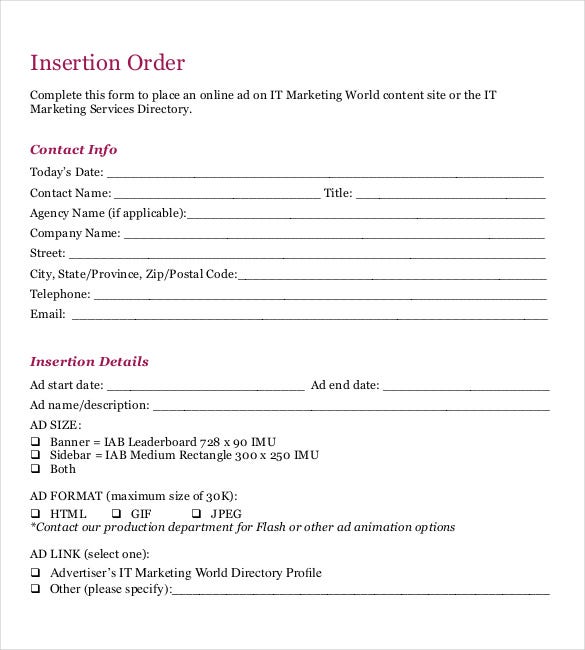
In order to place an ad in the newspaper, one has to fill an insertion order. This order gives specific date(s) on which the ad is to be published, the rate at which it is to be published, and production details preparatory to the publishing of the ad. Agencies provide newspapers the ad material in finished form.

If a small advertiser expects the newspapers to compose the ad, the newspapers first create a proof which is to be checked by the advertiser for correctness. Once the ad is run, a tear-sheet which is an actual page torn from the newspaper in which the ad was run is sent to the advertiser. It is a proof of publishing as per requirements. If there is an error, the advertiser or its agency can ask for rate adjustment or free insertion.


Newspaper buying:

Characteristics of Newspapers

1. Immediacy. Newspapers offer the greatest advantage of conveying the message quickly. They are flexible and so the advertising copy can be written very close to the time it goes to press. This characteristic is especially useful while launching new products or making public announcements. The advertisements can thus have a powerful new emphasis. For example. When the manufacturer of Good Knight launched “HIT” mosquito repellent, half page ads were inserted in the Times of India to announce this launch.

2: Selectivity. This is one of the greatest advantages in the Indian context. The advertiser can select the geographical area over which the message is to be communicated as also the language. Newspapers offer split-run facilities using which advertisers can test different campaigns in different geographical areas.

3. Newspapers Mechanical Requirements. Newspapers come in standard and tabloid sizes. Advertising space in newspapers is sold on the basis of columns and inches.

Most newspapers are largely printed on newsprint (a coarse paper stock) by high speed presses. Therefore, there are limitations on the kinds of illustrative materials that can be effectively reproduced. Newspapers have recently begun offering color supplements. For example, the Saturday Times of the Times of India, ET Esquire of The Economic Times and the Sunday supplements of most of the newspapers.

In addition to innovative color techniques, newspapers are adding other features to attract advertisers. Flexform advertising offers the advertiser the opportunity in any conceivable shape. Those parts of the newspaper page not containing the advertisement are filled with editorial matter. For example, the ads of Cinthol Lime, lime Lite and Liril have used the technique. Such unconventional layouts, surrounded by editorial matter are hard for the reader to ignore.

4. Variety: Most newspapers present a suitable variety of material to provide an interesting mix for a wide range of readers. A typical newspaper has sports, financial pages, society news, city news, shopping columns, comic strips and other features. Some pages are widely read by women, other by men interested in business news, and so on. An advertiser can select a target market by placing his advertisements in certain sections or pages of the paper.

5. Penetration: Morning newspapers are read by almost all the literate people. The readership is much more than the circulation. For example, the Times of India circulation is 7, 00,126 while its readership is 39, 36,000. Children are also keen readers of certain section

6. Types of newspaper: There are a wide variety of newspapers to choose from. Advertisers who wish to make announcements would use morning newspapers. For example, public issue of shares and debentures. The copy in the morning newspapers has to be short and attractively illustrated. The evening newspaper can be used to advertise family products such as refrigerators, television sets and cupboard, which require detailed explanation and long copy including special offers and hire-purchase schemes. Specialty newspapers such as The Economic Times can be used for business-to-business communication such as advertisements of SKF ball-bearing, HCL computers, and so on.


Advantages of Newspapers as an Advertising Medium 

1.      Prestige. The prestige and respectability of the newspaper is transferred to the advertised product /service.

2.      Segmentation. Editorial content of the newspaper influences the type of its readers and thus offers segmentation of the market. For example, “the Independent” claims that its readers are young decision-makers, highly educated and professional, while the Times of India has greater appeal among the middle and older age groups. The characteristics of selectivity and variety explained above increase the newspaper’s advantage in market segmentation.

3.      Flexibility. The newspapers offer tremendous flexibility to advertisers. When it is raining in Bombay, it may be hot in Delhi. While the Bombay newspapers can be used to advertise raincoats and umbrellas, the Delhi edition of the same newspaper can be used to advertise air coolers. The most important is the time flexibility that is the contents of the advertisement can be changed upto a few hours before the paper goes to press. MRF Tyres use the press medium just before the monsoons in Bombay by predicting the date of the first rainfall and thereby communicating to the consumers the urgency of changing to MRF Tyers before the monsoons.

4.       Split Run Facilities. Technique used to test the effectiveness of advertising copy. Two different versions of the same advertisement are printed in the same press run of an issue of a particular publication, so that some of the copies contain one version of the ad and the others contain the other version. The publication is distributed normally, but the distribution of the advertisements is split according to the request of the advertiser. Some advertisers split their run in alternate bundles; others prefer to split by geographic location or by subscription versus newsstand sales. The purpose of the split run is to compare the effectiveness of the two alternate ad copies. Advertisers will take advantage of this option when they desire to learn which of two elements used in the advertising will achieve the desired objectives. Elements that are often tested are prices, copy appeal, layout, type of illustration, coupon offered or no coupon offered, or premium or rebate offered or not. The results of split-run testing are revealed by the number of responses to each advertisement. The split-run option is offered as a convenience to advertisers. However, not all publications offer this option.

5.       Keying the advertisement. It is possible to key the advertisement and attach a mail order coupon in order to measure its effectiveness.

6.      Measuring Reach. The Audit Bureau of circulation (ABC) gives the readership and circulation figures and therefore it is possible to measure the reach of different newspapers.

7.      Mobility. Newspaper can be carried and read anywhere, while travelling, at the place of work, in library, in doctor’s waiting room and so on.


Limitation of Newspapers as an Advertising Medium

Despite the above advantages newspapers have the following limitations:

1.      Limited coverage. In India with the literacy, level being low newspapers cannot be used to penetrate the lower income segments of the market.

2.      Short Life. It is often said “as stale as yesterday’s newspaper.” A newspaper has a very limited life and therefore advertising will have little impact beyond the day of publication.

3.      Hasty reading. Studies indicate that people spend about 30 minutes on the paper. This means that the ad must make its impression quickly or it will fade.

4.      Cost. It is an expensive medium that is unsuitable for small advertisers especially the morning English newspapers such as the Times of India.

5.      Poor Reproduction. Most of the pages are in black and white and the colour advertisements are not as well reproduced as those in magazines. Therefore we rarely find food and fashion ads in newspapers.

6.      Demonstration and Display. It is not possible to demonstrate product usage as in television commercials.


Factors affecting the choice of newspapers are as follows 

1.      Circulation and Readership It is important to know who will notice our ad. Reach of a newspaper is given by circulation, which is the number of copies distributed each day for a daily or each week for a weekly. Paid circulation means the subscribed copies sold on stalls. Controlled circulation means free copies distributed. The circulation is certified by a body Audit Bureau of Circulation (ABC).

2.      Contract rate or earned rate is based on agreement. It gives a scheme of the number of ads or the amount space to be bought for earning a discount. If this condition is not satisfied an additional charge is levied called the short rate.  

Basically, ad rates are ROP – run of press, and ads can be placed anywhere on any page. But for special position, we have to pay more. If the same publication house publishes more than one newspaper, it can offer a combination rate which is lesser than the rate of buying in each individual media.

3.       Split Run Facilities. Many newspapers offer split run facilities. The split run test is a service used for testing print advertisements in which the media cooperate with an advertiser in allowing the same space for two or more copy variations to appear in systematic rotation through the entire circulation. This permits simultaneous circulation of two or more advertisements in identical editorial surroundings with comparable audiences.

4.       Advertising Rates. Most advertisers are constrained by their budgets and thus a newspaper that offers a competitive rate is most attractive. Publishing groups such as the Times of India offer special rates for booking space in several newspapers from the same group. (for example, an advertiser would get a competitive rate if he placed ads in the Times of India, Navbharat Times, The Economic Times and the Illustrated Weekly.

5.      Space Available. When the advertisement is to be published urgently, space availability may be the only determinant. The positions available in the newspaper are also of a prime consideration. The front page is the most attractive commands the highest rate. Certain other positions close to a popular section are also sought after by advertisers.  

6.      Language. This consideration is closely related to the profile of the readers. For products that have local markets, regional language newspapers are attractive. When an advertiser wants to appeal to a specified ethnic group he may use regional language newspapers. For example, a music group catering for Dandia Raas enthusiasts would find Gujarati newspapers the most suitable medium.

7.   Color. Many newspapers offer color supplements which are more attractive than the black and white section. Advertisers are willing to pay higher rates to enjoy the color advantage.

8.   Time of Issue. Morning newspapers attract advertisers of new products who make announcements that require immediate attention. The copy is short and it has less technical information. Afternoon newspapers attract advertisers of household products and entertainment, while Sunday newspapers attract a great deal of advertisers catering for women (color ads of Garden saris), children (ice-creams), men (industrial products).

9.   Editorial Policy. This factor plays a crucial role in today’s changing political scenario. Newspapers that are pro-government may find it easier to attract advertisers. Advertising in anti-establishment newspapers would imply that the advertiser is against the government and this may create problems such as delay in granting license and so on. Some newspapers are owned by political groups such as “Samna” by the Shiv Sena in Maharashtra. This also influences the reader profile.


Ref: Dr. Hanif Lakdawala's Media Planning and Buying Notes