Friday, 14 October 2022

BUSINESS COMMUNICATION I NOTES

 Business Communication – I Notes 

FYBAF/BMS/BBI/BFM 

Semester I 


Unit 4 : Language and Writing Skills 
1. Commercial Terms used in Business Communication 
2. Paragraph Writing : 
Developing an idea, using appropriate linking devices, etc.
 
Cohesion and Coherence, self-editing, etc. 
[Interpretation of technical data, Composition on a given situation, a short informal report, etc.] 


COMMERCIAL TERMS USED IN BUSINESS COMMUNICATION

1) BALANCE SHEET

The balance sheet documents a company’s financial health at specific points in time, usually at the end of the quarter or fiscal year. The balance sheet includes assets, liabilities, and equity and follows the accounting equation:

Assets = liabilities + equity.

The left side leaves you with what you own, whereas the right side shows what you owe. Your asset values should equal those of your liabilities and equity. 

2) ASSETS 

Assets are resources that businesses control, in which the owner expects assets to generate future cash flow. Examples include inventory, equipment, and land. 

3) LIABILITIES 

Liabilities are debts, usually sums of money, that a business owes to another entity. Examples include expenses payable to suppliers, accounts payable, and business loans. 

4) EQUITY

Shareholders’ equity (SE) tells you a company’s net value if liquidating assets paying off debts. To calculate shareholders’ equity, subtract total liabilities from assets:

Shareholders’ equity = total assets−total liabilities

5) INCOME STATEMENT

The income statement shows the business’s performance during a period, such as throughout the quarter or year. Focusing on revenue and expenses, the income statement depicts a company’s profit or loss. 

6) REVENUE

Revenue refers to the income generated from a business’s operations and activities. One way to calculate revenue is by multiplying the price of an item by the quantity sold.

7) EXPENSE

Expense refers to money spent on utilities, salaries, and raw materials, and other items that a company incurs operating the business.

8) PROFIT 

Also known as “net income” or the “bottom line”, your profit shows the difference between what a business earns and spends. Calculate profit earned by subtracting total expenses from total revenue. 

Profit = total revenue - total expenses

9) NET LOSS

Using the profit equation, you can calculate a business’s net loss, or when total expenses exceed total revenue and the difference is negative. 

10) CASH FLOW STATEMENT

A cash flow statement measures the cash generated (inflow) or used (outflow) by a company in a given period. Classify cash flow under operating, investing, or financing activities.

11) PROFIT MARGIN 

Three types of profit margins are gross profit, net profit, and operating profit margin. Calculate your profit margins by dividing profit by revenue. Profit margins show a company’s growth potential and answer how much of each dollar of sale generates into profit. 

Profit margin = (profit / revenue) x 100% 

Note: more revenue does not always translate to higher margins and more profit kept from sales. 

12) RETURN ON INVESTMENT (ROI) 

Return on Investment (ROI) is a ratio measuring performance efficiency relative to how much a company spent on investments. Calculate ROI by dividing net profit from the investment cost. 

ROI = (net profit / investment cost) x 100% 

13) VARIABLE COST 

Variable costs change proportionally to production. For example, the cost of raw materials increases with the number of units purchased.

14) FIXED COST 

Unlike variable costs, fixed costs stay the same regardless of changes in production. For example, a company pays the same amount in monthly rent. 

15) CASH FLOW

Cash flow is a measure of the amount of cash generated (or lost) through a businesses's operations. It's different than net profit, as net profit includes non-cash expenses (such as depreciation), and excludes some uses of cash (such as capital expenditures for new equipment, or repayment of outstanding debt). 

16) BUSINESS TO BUSINESS (B2B) 

B2B transactions take place when a company sells goods or services to another company.

17) BUSINESS TO CONSUMER (B2C) 

B2C transactions occur when a company sells goods or services to end-users.

18) BEST PRACTICE 

Best practices are accepted as standard methods for executing a task for how they most effectively produce results. 

19) DECK

This term is commonly used to describe a PowerPoint presentation. You could think of it as a “deck” of PowerPoint slides.

20) DELIVERABLE 

A deliverable is a final product given to the client at the end of a project. A deliverable can include decks, research, and financial models. 

COHESION AND COHERENCE


Difference Between Coherence vs Cohesion                            Whenever we write documents, articles, blogs, descriptions, brochures, or advertisements, it is necessary to make sure that the content is understandable and that the written material flow is integral. How your ideas are conveyed through the written sentences consisting of logical transitions when you switched from one to another is another crucial point. Cohesion and coherence are the two important things considered while writing any content and are properties of written material considered in discourse analysis and text linguistics.                                              The word cohesion word is derived from the word cohere, which means “to stick together”. So while framing the sentences and phrases, cohesion is how you have put your ideas and views collectively together while framing your sentences while coherence is the superset of cohesion which includes cohesive sentences as well as other properties like consistency and understandability of the content and how using logically connected and related sentences while representing your ideas and transiting from one idea to another.                                                                

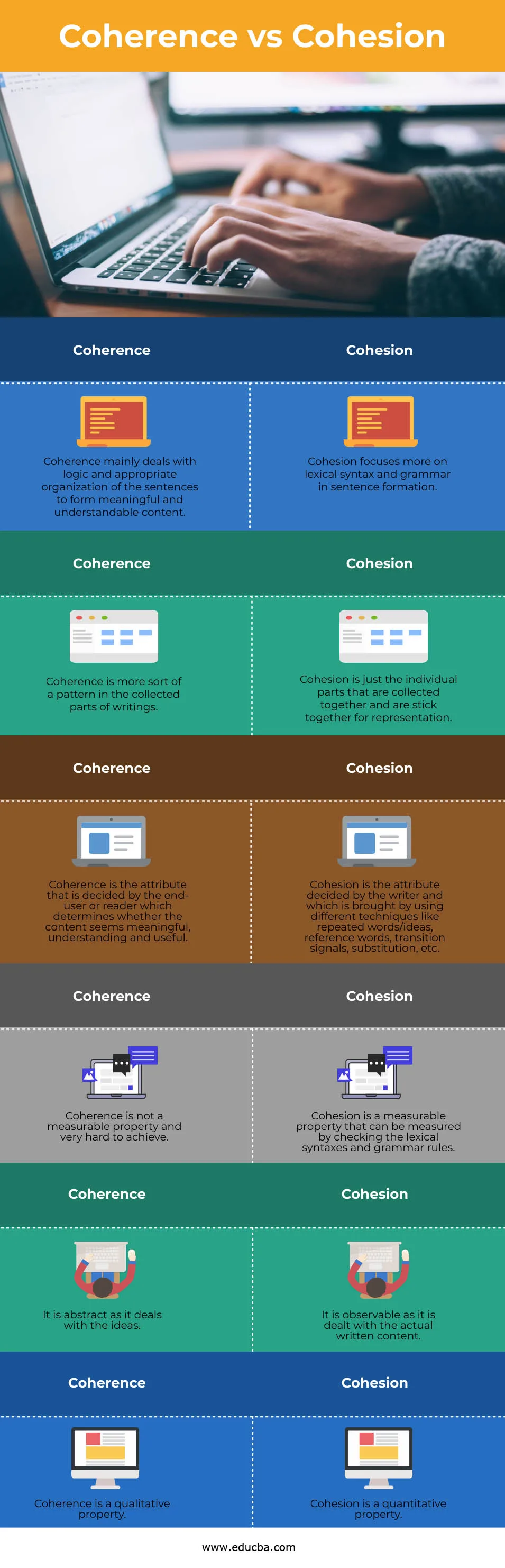
Coherence vs Cohesion info

Key Difference Between Coherence vs Cohesion

Let us discuss some of the major key differences:

  • Let us see with the help of an analogy of a building. The building represents coherence, while the bricks represent cohesion. Bricks are internally strong because their content is stick together. Similar is the case with sentences and paragraphs is they are grammatically correct and represent a certain idea. But when these sentences and paragraphs are put together to form our writing, then the coherence is determined with the help of parameters like the organization of the cohesive components and connection of the ideas and understandability of the content as a whole. In our above example, when the bricks( cohesive objects) are organized together, then only the building(coherence) is constructed.
  • The cohesion properties focus only on the grammatical and lexical structure of sentences, while coherence deals with the semantics. The cohesive content doesn’t need to be always coherent. But coherent content is always cohesive as it is the arrangement of cohesive sentences together to put up a meaningful and understandable article.
  • It can be understood with the help of one more example of puzzling pieces that are connected to form a particular picture. Even if the shape and size of parts fit correctly does not conclude that the picture is correct. Proper placement and arrangement of the pieces will only ensure the formation of the picture.
  • Repeated words/ideas, reference words, transition signals, substitution, and ellipsis are some of the techniques which can be used to achieve cohesion while topic sentences, thesis statement, the summary are the techniques used to achieve coherence. Coherence can be improved with the use of an outline of the content, which can be made before writing the articles or even after completion of writing, giving us an understanding of the flow of ideas and concepts in the article and their relationship.
  • Peer review can also help in enhancing coherence. You can ask your peers for feedback about your content and see whether they can understand what you are trying to convey through your content.

Coherence vs Cohesion Comparison Table

Let’s discuss the top comparison:

Coherence

Cohesion

Coherence mainly deals with logic and appropriate organization of the sentences to form meaningful and understandable content.Cohesion focuses more on lexical syntax and grammar in sentence formation.
Coherence is more sort of a pattern in the collected parts of writings.Cohesion is just the individual parts that are collected together and are stick together for representation.
Coherence is the attribute that is decided by the end-user or reader, which determines whether the content seems meaningful, understanding and useful.Cohesion is the writer’s attribute and which is brought by using different techniques like repeated words/ideas, reference words, transition signals, substitution, etc.
Coherence is not a measurable property and very hard to achieve.Cohesion is a measurable property that can be measured by checking the lexical syntaxes and grammar rules.
It is abstract as it deals with the ideas.It is observable as it is dealt with the actual written content.
Coherence is a qualitative property.Cohesion is a quantitative property.

Conclusion

Cohesion and coherence are the two properties used in discourse analysis and text linguistics to determine the quality of the article or any content written. Cohesion means sticking together different sentences, phrases, and paragraphs with each other. Cohesion is completely in the hands of the writer and can be improved by using different techniques. Coherence is the property determined by the reader, which tells the understandability of the article and whether the idea is being conveyed to the reader appropriately. It determines the quality of the content. Cohesion is a subset of coherence. Hence, whenever cohesion is achieved, we can’t say the coherence is achieved or not, but if coherence is achieved, then the content is cohesive too for sure.

LETTER OF RESIGNATION

A resignation letter is a formal document notifying an employer that you are leaving your job.

A resignation letter includes notice that you’re resigning, your end date of employment, and your contact information. You can include additional details, but they are not required.

Resignation letters can be submitted in print or sent by email. In some cases, you may want to share a printed letter with a manager in person.

What Is a Resignation Letter?

A resignation letter is a document that notifies your employer that you are leaving your job. It formalizes your departure from your current employment and can be submitted by email or as a printed letter.

The letter serves as written notice of your resignation and provides the details of your departure from employment, including information about the end date of your employment.

It's polite to send your resignation letter well in advance of your departure, with two weeks in advance being generally accepted as the minimum unless circumstances require that you resign without advance notice or with short notice.

In some cases, you may not be able to provide notice. If you’re working in a difficult workplace, have a family emergency, or other circumstances require you to move on right away, give your employer as much notice as is feasible given the situation. 

If you have an employment contract, it’s important to adhere to its terms when you’re resigning. Check your contract to determine how much notice you need to give your employer.

If you tell your boss in person that you're resigning, have a printed copy of your resignation letter ready to share. When you work remotely or resign with short notice, however, you can send your resignation via email.

What To Include in a Resignation Letter

When you resign from your job, it's important to do so gracefully and professionally. However, you don't need to include a lengthy explanation. Keep your letter or email simple and focused on the facts.

Here's an overview of what to include in your letter:

  • Your Intent to Resign: Your letter should start with the fact that you're resigning.
  • Your Last Day of Employment: You should provide information about the last day you plan to work at the company.
  • An Offer to Assist with the Transition: Often, employees will also offer to help in the transition, perhaps by recruiting or training a replacement. In this way, both the employee and the employer can leave the situation with closure and a sense of respect and amicability.
  • Questions You May Have: If you have questions about your final pay or benefits, you can inquire in your letter or email.
  • Your Contact Information: Include your personal contact information so it's easy for the company to get in touch with you.
  • Your Signature: A hard-copy letter should include your written signature above your typed name. If you're sending an email, simply type your name.

To achieve a positive and graceful exit, a letter of resignation will often thank the employer for the opportunities provided and mention experiences gained at the company or how the employee enjoyed their time there.

What Not to Include in Your Letter

There are some things you shouldn't include when writing a resignation letter:

  • You don’t need to include the reason that you’re moving on, especially if it’s a negative one.
  • Resignation letters are not an appropriate place for complaints or critiques of the company, manager, or co-workers.
  • There’s no need to mention in your letter that you'll be getting a higher salary at your new job (if you are). If you’re looking for a counteroffer to induce you to stay, that conversation is better held in person.
  • Don’t use your letter to discuss how great the new job is or how thrilled you are about leaving.
  • Note: Keep it simple, stick to the facts, and don't complain. It's important to leave on a positive note because you may need a reference from the employer. There's no point in burning bridges when you've already made the decision to move on.

How To Write a Resignation Letter

A resignation letter needs to include your contact information, official notice that you’re resigning, and when your final day of work will be. If you’d like to include more details you can, but they are not required.

Here’s how to write a resignation letter, with information on what to include in each section of the letter:

Contact Information (Written Letter): A written letter should include your and the employer's contact information (name, title, company name, address, phone number, email), followed by the date.

Contact Information (Email): In an email resignation letter, include your contact information at the end of the letter, after your signature. You don’t need to include the company’s contact information.

Greeting: Address the resignation letter to your manager, using their formal title ("Dear Mr./Ms./Dr.").

Paragraph 1: Note that you are resigning from your job and state the date on which your resignation will be effective. This will give the employer official notice for your personnel file.

Paragraph 2: (Optional) You can mention the reason you're leaving, but this is not required. If you choose to give a reason, be sure it’s a positive one, such as starting a new job, leaving the workplace, or going back to school.

Paragraph 3: (Optional) If you’re able to help with the transition, mention your availability in your letter.

Paragraph 4: (Optional) Mention your appreciation for the opportunity you had to work for the company. If there was something that was especially rewarding, share the details.

Closing: Use a formal sign-off, such as "Sincerely" or "Yours sincerely."

Signature (Written Letter): End with your handwritten signature followed by your typed name.

Signature (Email): Include your typed name followed by your contact information.

LETTER OF ACCEPTANCE OF JOB

 Acceptance Letter Sample

14 Shantivanam

Chandigarh

25 April 2020


to,

Ms. Mary Lou Fernandes

Manager of Human Resources

XYZ Corporation

2901 Gods Gift

Mumbai 400050


Subj: Letter of Acceptance


Dear Ms. Fernandes:

I am writing to confirm my acceptance of your employment offer on April 20 and to tell you how

delighted I am to be joining XYZ Corporation in Mumbai. The work is exactly what I have

prepared to perform and hoped to do. I feel confident that I can make a significant contribution to

the corporation, and I am grateful for the opportunity you have given me.

As we discussed, I will report to work at 8:00 am on May 1 and will have completed the medical

examination by the start date. Additionally, I shall complete all employment and

insurance forms for the new employee orientation.

I look forward to working with you and your fine team. I appreciate your confidence in me and

am very happy to be joining your staff.

Sincerely,

Sandra B. Rodriguez

STATEMENT OF PURPOSE | SOP

A Statement of Purpose (SOP), is a reflection of your personality that you portray in front of the admissions committee (AdCom) for getting enrolled in universities abroad. It is your chance of impressing the committee by presenting your profile strongly through an essay that describes your personality traits, which are not covered in your academic documents.

What is SOP?

An SOP is a long essay required by universities abroad and nowadays some of the Indian universities during the application process. A Statement of Purpose is an essay stating the purpose of applying to a particular course in a particular university. This essay consists of a gist of who you are, who you want to become, and how ready you are to pursue a certain course in an institution.

The document seeks to understand the candidate’s life, the motivations for the chosen career path and his/her goals. Hence, you should discuss the past incidents that have influenced your career path in a specific domain wherein you aspire to grow by joining a course/college.

Why is SOP important?

A well-written SOP is extremely critical to your admission. There are many aspects of a candidate’s application that are inspected before finalising a decision. While the academic record and other exam scorecards/academic transcripts and backlog certificates are essentially objective in nature, an SOP is the only truly subjective aspect of your application.

It is the only document in your application that gives you the opportunity to prove that you have something unique that makes you stand out from the crowd. As such, it is the document of your application docket that can hugely determine your admission.

What is the General Statement of Purpose Format?

Most universities across the globe have a standard format/template that is acceptable. However, the content in SOP varies with different kinds of courses.

While there are a number of formats and samples available online for an SOP that aspirants can use for SOP writing, it is difficult to choose the right format. 


What do colleges look for in an SOP?

While drafting your SOP, you need to keep in mind that the admission committee will be reviewing thousands of applications for the same course. Thus, not only your SOP needs to be crisp and precise, but it should also highlight the uniqueness in your profile. Here are a few things that the college review committee generally look for in a student’s SOP:

  • Your writing capability is reflected in your SOP. Your SOP should be free from grammatical errors. The language should be lucid enough for them to comprehend yet should have a good vocabulary. Make sure not to use too many heavy words as sometimes too much rich vocabulary makes the sentence redundant and it fails to communicate the meaning.
  • What makes you stand out from the rest of the crowd? Highlight your unique side/unique personality. The Adcom should be able to recognize you an as individual through your SOP. Your interests and goals will help them know you on a personal basis.
  • With your talent, previous experiences and interest, how and what can you contribute to the department and college/university, as a whole? Think of it as a two-way process. If you receive an admit, your career will get a kick-start and through your efforts and participation, the department/college can receive benefits. You need to mention how you will be able to contribute to their community, be it through sports, community services, societies or clubs, and so on.
  • Being familiar with the university facilities and curriculum will help you a great deal. You need to be aware of the student programmes, faculty, internship opportunities, student facilities and societies, traditions etc that sets the university apart from others. The Adcom should be convinced that you know about the department and college/university thoroughly and thus, you are applying in it and not applying randomly.
  • Your motivation or inspiration to study a selected course should be clear, evident and justified. Adcom does not approve of bragging sentences in the SOP. So keep it original, real, and free from any overbearing or arrogant statements.

How to make your SOP stand out from the Crowd?

Now that we have assessed how important your SOP is, we come to the important part – how to write an SOP that stands out amongst 1000s of applicants every year. There are obviously some basics about SOP writing, which clear what all you need to keep in mind like general word limit, format, etc.

What is important to note, is that you must, at all times, remember which course you are writing the SOP for. For example, if you are talking about studying Computer Science in a country, you must discuss all your encounters, experiences, and learnings of Computer Science. Do not miss out on anything important and do not talk about the rest of the things too much.


How long should a statement of purpose be?

Statement of Purpose should be 1-2 pages long, ideally wrapped in 800-1000 words. However, the length of this document may vary as per university-specific requirements. Some universities have a fixed length and pattern of SOPs required, which is fixed to 500 words only, even 200 words in some cases. Most of the universities accept generic length, which is 800-1000 words, which may go beyond 1000, but not exceed 1200 words, in some cases.

It is generally easy to write a story of your life explaining the importance of each incident in shaping or moulding your character. However, when it comes to defining your SOP within the communicated word limit by some universities, the challenge is to portray your best within limited words. In such cases, it is better to mention the major achievements from every place you have been to such as school, college, office, etc.

Some abroad universities do not require SOP, they rather give you Essay Prompts along with a word limit. 

What to Include in an SOP?

There are many elements to an SOP. Universities could ask question-based essays or simply a general statement of purpose. Until and unless categorically asked, an SOP must include your goals and the career path you have taken up so far as well as your academic progress. Other elements that are further important to the SOP are also the personal motivations that lead you to choose the university/course you have applied to as well as how you intend to use that experience to achieve that goal.

What not to include in an SOP?

Remember that there is no exhaustive list of what you can include in an SOP. What you need to remember is that in such a case, it becomes equally important to understand what you must not include in your SOP. For instance, should you talk about your family? What about your school life? Every organization I have ever worked with? All my extracurricular achievements?

Strategies to Write a Powerful and Convincing SOP

Whether applying for undergraduate, graduate, or post-graduate programmes, the strategy of writing a powerful statement of purpose would be to sound focused throughout. Starting from your academic and professional background to your career aspirations, you need to carefully connect all the dots between reaching your goals through your choice of school and course.

The essay should always go in a flow covering your past experience, present involvements, and future plans. An important point to remember while writing your SOP would be to divide it into paragraphs that cover all the pointers. Here is a look at how you may write the SOP presenting your profile strongly:

Introduction of SOP: 1st Paragraph

This paragraph is often confused with self-introduction. It should not introduce you but should discuss what you are about to discuss in your SOP. There are multiple approaches you may adopt to go about this paragraph:

  • Discuss your long-term goal and connect it with your idea of pursuing the course you are applying to
  • Present your understanding of the chosen field and write how you want to contribute to that field
  • Explain your background in 2-3 lines and connect it with your future goals
  • Write about an anecdote that helped you realise your professional interest in the chosen field

Students often make the mistake of introducing themselves or their childhood in the first paragraph. In some cases, students tend to forget about the purpose behind writing an SOP. 

SOP 2nd and 3rd Paragraphs: Academic Background and Professional Experience

This comprises of your academic background: what you have done so far, what you are currently pursuing, your academic strengths and projects, industrial exposure you have attained, etc. If you have any professional experience it should be discussed in the upcoming paragraphs. 

SOP 4th Paragraph: Why This Course?

In this paragraph, you should discuss why you want to join a course and what modules would you tap during this course. It should also cover the skills you would acquire in this duration along with the exposure that would help in developing the skills desired to realise your goals.

SOP 5th Paragraph: Career Goals

This is the most important paragraph, where you should discuss your short and long-term goals. Your immediate goal would be where you would want to work right after completing this course. You should be able to name some companies within India along with the designation you see yourself working at. This should explain the kind of job profile you would be working on.

Then comes your long-term goal, wherein you should mention where you see yourself from 10-12 or 15 years down the line. This may include your desire of working at the CEO/CFO/CTO level or maybe establish a firm that you own. It may also include your dream of expanding your existing family business overseas. You may also be interested in further studies like a PhD which can be included here.

More in this section may include your desire of becoming a professor or researcher. In any case, it is suggested that you discuss your business aim, principles, and core values or how you would influence the young aspirants of this industry. You should be able to portray 'how you wish to make a difference in the industry keeping in mind the current industrial scenarios and emerging trends'.

SOP 6th Paragraph: Why This University?

This is a specific paragraph wherein you can convince a university as in how they are suitable for your profile and you are an ideal candidate for their university. You should discuss the course curriculum, research work, faculty names, as well as the university-specific activities that would help you in enhancing your profile.

Closing Paragraph of SOP

In this paragraph should conclude your desire and readiness towards joining the chosen course. Since this is the closing paragraph, you should sound focused and prepared for all the challenges that came your way. It should also show that you have the zest in you to succeed and with the help of the chosen course and university you will definitely make a difference in the industry on a global perspective.